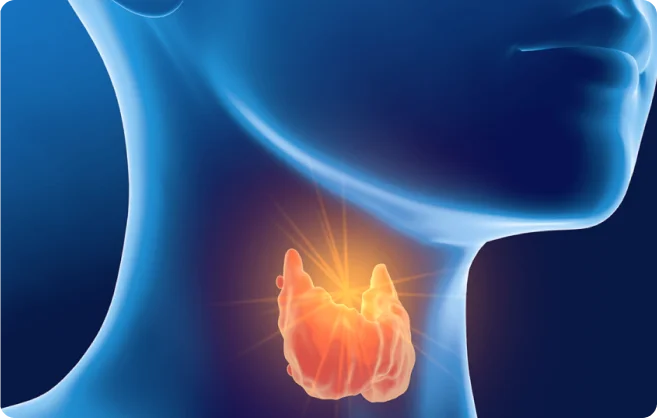
The thyroid.
About Hashimoto’s Thyroiditis
Hashimoto’s thyroiditis is an autoimmune disease in which the body’s immune system turns against itself and attacks the thyroid.¹ This leads to the gradual, long-term destruction of the thyroid gland, and therefore insufficient levels of thyroid hormones.¹ As the disease progresses, the thyroid may produce too few thyroid hormones, resulting in hypothyroidism.¹



Who is at risk?
Hashimoto’s thyroiditis can affect any individual at any age, but mostly occurs in middle-aged women and people with a family history of thyroid disorders.¹ Why the immune system attacks the thyroid gland is not yet known, but possible risk factors include viral or bacterial infection and having another autoimmune disease such as type 1 diabetes.²
Symptoms of Hashimoto’s disease
This disease can go unnoticed for a long time. In the course of the disease the thyroid gland can become exhausted, and you might develop hypothyroidism with symptoms such as:¹,³
- Fatigue and drowsiness and/or weakness
- Cold intolerance
- Difficulty concentrating or thinking
- Depression
- Weight gain
- Enlarged neck or presence of goiter, which may be an early symptom, and, later in the disease, a small or shrunken thyroid gland
- Abnormal menstrual periods with heavy/irregular menses
- Constipation
- Joint or muscle pain
- Hair loss
- Dry skin
How Hashimoto’s thyroiditis is diagnosed
People with Hashimoto’s thyroiditis often present symptoms of hypothyroidism, sometimes accompanied by the finding of a goiter.³ Symptoms alone are not a reliable proof of this disease. Blood tests are needed to make a valid diagnosis. If you have high levels of TSH in the blood and low levels of free T4 (thyroxine circulating freely in the blood) you probably have hypothyroidism.⁴ Antibodies against thyroid peroxidase, an enzyme involved in the production of thyroid hormones, are usually elevated in cases of Hashimoto’s thyroiditis.³
Treatment for the disease
If you are diagnosed with Hashimoto’s thyroiditis your doctor will prescribe thyroxine replacement hormone to treat this condition.¹ Most patients with Hashimoto’s thyroiditis will require lifelong treatment with the appropriate medication.³ Finding the appropriate dose, particularly at the beginning may require testing with TSH every 6-8 weeks after any dose adjustment, until the correct dose is determined. After that, monitoring of TSH once a year is generally sufficient.³
Useful websites
http://www.thyroid.org/Patient information on thyroid health published by the American Thyroid Association.
http://www.thyroid-fed.org/Patient information from Thyroid Federation International.
http://www.merckserono.de/Therapiegebiete/Endokrinologische Erkrankungen/Schilddrüse/Broschüren „Ihr Hashimoto Ratgeber“ und „Ihr Basedow Ratgeber”

- Medline Plus. Chronic thyroiditis (Hashimoto’s disease). Available at http://www.nlm.nih.gov/medlineplus/ency/article/000371.htm. Last accessed February 2025.
- Mayo Clinic. Hashimoto’s disease. Symptoms and causes. Available at http://www.mayoclinic.org/diseases-conditions/hashimotos-disease/symptoms-causes/dxc-20269764. Last accessed February 2025.
- American Thyroid Association. Hashimoto’s thyroiditis (lymphocytic thyroiditis). Available at http://www.thyroid.org/wp-content/uploads/patients/brochures/Hashimoto_Thyroiditis.pdf. Last accessed February 2025.
- British Thyroid Foundation. Thyroid function tests. Available at http://www.btf-thyroid.org/information/quick-guides/97-thyroid-function-tests. Last accessed February 2025.